This book has sections about natural storage...ever wondered how to properly store onions for the winter? This book explains it and shows you how! There are also sections on drying fruits and vegetables (without a fancy dehydrator), freezing fruits and vegetables (including a list of what freezes well), and of course the jams, jellys, chutneys, preserves, and pickles. There are also instructions for preserving in oil and canning fruit in alcohol. There is then a section about salting meats and vegies, curing meats, smoking meats, and making sausages (like fresh chorizo.) Finally there is a small section about brewing and wine-making.
Showing posts with label Canning. Show all posts
Showing posts with label Canning. Show all posts
Wednesday, August 1, 2012
Preserve It!
I love books published by DK publishers...they have great pictures and easy instructions. The book PRESERVE IT! is another great offering from DK.
This book has sections about natural storage...ever wondered how to properly store onions for the winter? This book explains it and shows you how! There are also sections on drying fruits and vegetables (without a fancy dehydrator), freezing fruits and vegetables (including a list of what freezes well), and of course the jams, jellys, chutneys, preserves, and pickles. There are also instructions for preserving in oil and canning fruit in alcohol. There is then a section about salting meats and vegies, curing meats, smoking meats, and making sausages (like fresh chorizo.) Finally there is a small section about brewing and wine-making.
This book has sections about natural storage...ever wondered how to properly store onions for the winter? This book explains it and shows you how! There are also sections on drying fruits and vegetables (without a fancy dehydrator), freezing fruits and vegetables (including a list of what freezes well), and of course the jams, jellys, chutneys, preserves, and pickles. There are also instructions for preserving in oil and canning fruit in alcohol. There is then a section about salting meats and vegies, curing meats, smoking meats, and making sausages (like fresh chorizo.) Finally there is a small section about brewing and wine-making.


Monday, July 23, 2012
Freezing Corn
Usually the corn-on-the-cob comes into season in Nebraska around the middle of July. Of course, this year has been extraordinarily H-O-T...so the corn was ready a month early. Anyway, I did find some corn to freeze this year. I thought you might like to see how I get the corn from the farmers' market to the freezer.
I know this is not a "healthy" way to preserve corn, but it sure tastes awesome. This is the way Trevor's mom taught us to freeze corn. It's awesome on mashed potatoes instead of gravy OR in chicken and noodles.
One year we ended up with 18 dozen ears of corn. Trevor's mom and dad, Trevor, and I processed corn ALL DAY LONG...we didn't want any corn for quite some time.
From 5 dozen ears, I got 17 - 2 cup packages of frozen corn. Amounts will vary based on the quality of the corn and how good (or bad) the person is at cutting the corn from the cob.
How do you prefer preserved corn?
Have a wonderful week, and take care of you!
- Purchase the corn. (I purchased 5 dozen ears of corn, but I process no more than 3 dozen ears at a time in the roaster.)
- Shuck the corn, cutting off any bad spots.
- Clean the corn thoroughly removing as much silk as possible.
- Using an electric knife, cut the corn off the cob.
- Be careful to NOT cut cob into your corn. Cob just doesn't taste very good.
- I use a jelly roll pan to cut the corn into (instead of a cutting board) because I want to keep the corn "milk" for the finished project.
- Discard the cobs unless you want to dry them for cheap TP (I'm really suggesting that you NOT do this...really)
- Dump the corn into a turkey roaster (or other large pan with a lid.)
- Once all of the corn (3 doz ears worth) is in the roaster, add 1 quart of heavy cream or half-n-half. Stir the corn to coat. Put four sticks of butter (1 lb.) on top of the corn. Put the lid on the roaster.
- Bake in the oven at 250 F for one hour--stirring thoroughly every 15 minutes.
- After the corn has baked for an hour, let the corn set out until it is cool enough to handle. Put two cups (or whatever amount works best for your family) into a freezer bag. [TIP: I use a canning funnel when putting the corn in the freezer bags to keep messes to a minimum.]
- Freeze. I flatten the bags so that they don't take a bunch of room in the freezer.
 |
| Corn -- after it has been cut off using the electric knife. |
 |
| Corn -- after it has been baked. |
 |
| Corn -- after it has been frozen -- stacked in the freezer. |
One year we ended up with 18 dozen ears of corn. Trevor's mom and dad, Trevor, and I processed corn ALL DAY LONG...we didn't want any corn for quite some time.
From 5 dozen ears, I got 17 - 2 cup packages of frozen corn. Amounts will vary based on the quality of the corn and how good (or bad) the person is at cutting the corn from the cob.
How do you prefer preserved corn?
Have a wonderful week, and take care of you!
Wednesday, June 20, 2012
Can It, Bottle It, Smoke It and Other Kitchen Projects
This week's book selection is another book to inspire your home canning adventure. CAN IT, BOTTLE IT, SMOKE IT by Karen Solomon has chapter recipes for:
I kind of felt like this was a "sampler" book. Instead of focusing on a narrow part of food preservation, the book has a few recipes (4-5) for each chapter. If you are looking for a wide variety of a certain type of recipe, this won't be the book for you.
Also, I kind of had a hard time deciding/choosing a recipe to try for a couple of reasons.
(1) Many of the recipes had "strange" ingredients...ingredients that I cannot readily find in my little Nebraska town OR ingredients that I had never heard of, and am therefore, uncertain about spending my funds to obtain. Some of you may think that ingredients I consider "strange" are common to you...it takes all kinds...
(2) Some of the recipes that I might consider because they are products I purchase had long time commitments or produced very little for the time commitment required.
** For example **
Homemade Vinegar takes a "strange" - vinegar starter (Mycoderma aceti) AND takes around 3 months to produce 1 1/2 cups. Holy Cow!!! Do you know how much vinegar I use?!? I buy 2-3 gallons a month! Obviously, this was not the experiment for me.
Worcestershire Sauce also takes "strange" ingredients of tamarind paste, fish paste, and blackstrap molasses. The recipe calls for 1 Tbsp. of molasses (which I can probably obtain here, but not in that amount. What am I going to do with the other ton that I had to purchase?) The time commitment was 2 weeks for 1 1/2 cups. That's probably about how much Worcestershire Sauce I use in a year...but then I'm left with lots of "extra" "strange" ingredients. It would definitely not be a cost effective recipe for me. Maybe you have all of the stuff already, so this would be a great recipe for you.
I had Trevor look through the book to see if there was something he thought he'd like me to make. I didn't want to just make another jam, so I asked him to pick something other than a jam. He picked Sweet Pepper and Corn Relish. I asked him for what do you use corn relish? He didn't know for sure, but he thought it would be good for corn chips...maybe added to sour cream...
It was a small batch, so I'm game to try it. There was nothing strange, and it didn't require much time. I honestly got out of bed at 8 AM and had the relish out of the water bath before 10 AM. I wasn't particularly organized that day either. The only thing I had done prior to that morning to prepare for making the relish was purchase the ingredients. Two days before I canned the relish, I was debating about buying the red peppers, corn, and red onion. When we went grocery shopping, I found an unadvertised sale on red peppers for $0.50 each. That is CHEAP for my part of Nebraska...they are usually at least $1.25 each. I decided that was my sign that I was supposed to make this stuff!
As for most canning recipes, it did make a bit more than the recipe stated. The time commitment stated was "1 day" -- I think this must be the amount of time the relish should be allowed to cure because it took less than two hours to actually make the relish, the brine, combine the two, and hot water bath can the jars.
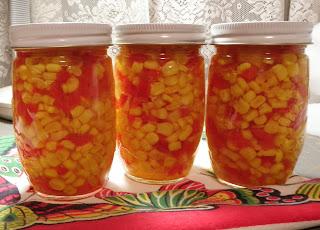 Later that day, my father-in-law (Howard) came over to see if I had any strawberry preserves left because he wanted waffles for dinner. I gave him the preserves and offered him a jar of corn relish to try. He said, "I haven't seen anyone make corn relish since my mom made it when I was a kid." (Howard's mom died in 1972--before I was born.) I asked him what they used the relish for...he couldn't remember, but he thought he might remember when he tasted it. We'll see about that.
Even though there are just a few recipes on a wide range of topics, it's still worth a trip to your local library to check it out. Maybe it has the recipe you've been searching for!
Do you know what to use Sweet Pepper Corn Relish for??
Have a great day, and take care of you!
- jams,
- cereals,
- pantry stock (like vinegar and Worcestershire sauce),
- pickles,
- breads,
- roasted items (coffee beans and nuts),
- meats (hot dogs and pastrami),
- smoked fruits and cheese,
- salty snacks (fried pork rinds),
- sweet spreads, milks (almond and rice),
- syrups and sodas,
- and freezer treats.
I kind of felt like this was a "sampler" book. Instead of focusing on a narrow part of food preservation, the book has a few recipes (4-5) for each chapter. If you are looking for a wide variety of a certain type of recipe, this won't be the book for you.
Also, I kind of had a hard time deciding/choosing a recipe to try for a couple of reasons.
(1) Many of the recipes had "strange" ingredients...ingredients that I cannot readily find in my little Nebraska town OR ingredients that I had never heard of, and am therefore, uncertain about spending my funds to obtain. Some of you may think that ingredients I consider "strange" are common to you...it takes all kinds...
(2) Some of the recipes that I might consider because they are products I purchase had long time commitments or produced very little for the time commitment required.
** For example **
Homemade Vinegar takes a "strange" - vinegar starter (Mycoderma aceti) AND takes around 3 months to produce 1 1/2 cups. Holy Cow!!! Do you know how much vinegar I use?!? I buy 2-3 gallons a month! Obviously, this was not the experiment for me.
Worcestershire Sauce also takes "strange" ingredients of tamarind paste, fish paste, and blackstrap molasses. The recipe calls for 1 Tbsp. of molasses (which I can probably obtain here, but not in that amount. What am I going to do with the other ton that I had to purchase?) The time commitment was 2 weeks for 1 1/2 cups. That's probably about how much Worcestershire Sauce I use in a year...but then I'm left with lots of "extra" "strange" ingredients. It would definitely not be a cost effective recipe for me. Maybe you have all of the stuff already, so this would be a great recipe for you.
I had Trevor look through the book to see if there was something he thought he'd like me to make. I didn't want to just make another jam, so I asked him to pick something other than a jam. He picked Sweet Pepper and Corn Relish. I asked him for what do you use corn relish? He didn't know for sure, but he thought it would be good for corn chips...maybe added to sour cream...
It was a small batch, so I'm game to try it. There was nothing strange, and it didn't require much time. I honestly got out of bed at 8 AM and had the relish out of the water bath before 10 AM. I wasn't particularly organized that day either. The only thing I had done prior to that morning to prepare for making the relish was purchase the ingredients. Two days before I canned the relish, I was debating about buying the red peppers, corn, and red onion. When we went grocery shopping, I found an unadvertised sale on red peppers for $0.50 each. That is CHEAP for my part of Nebraska...they are usually at least $1.25 each. I decided that was my sign that I was supposed to make this stuff!
As for most canning recipes, it did make a bit more than the recipe stated. The time commitment stated was "1 day" -- I think this must be the amount of time the relish should be allowed to cure because it took less than two hours to actually make the relish, the brine, combine the two, and hot water bath can the jars.
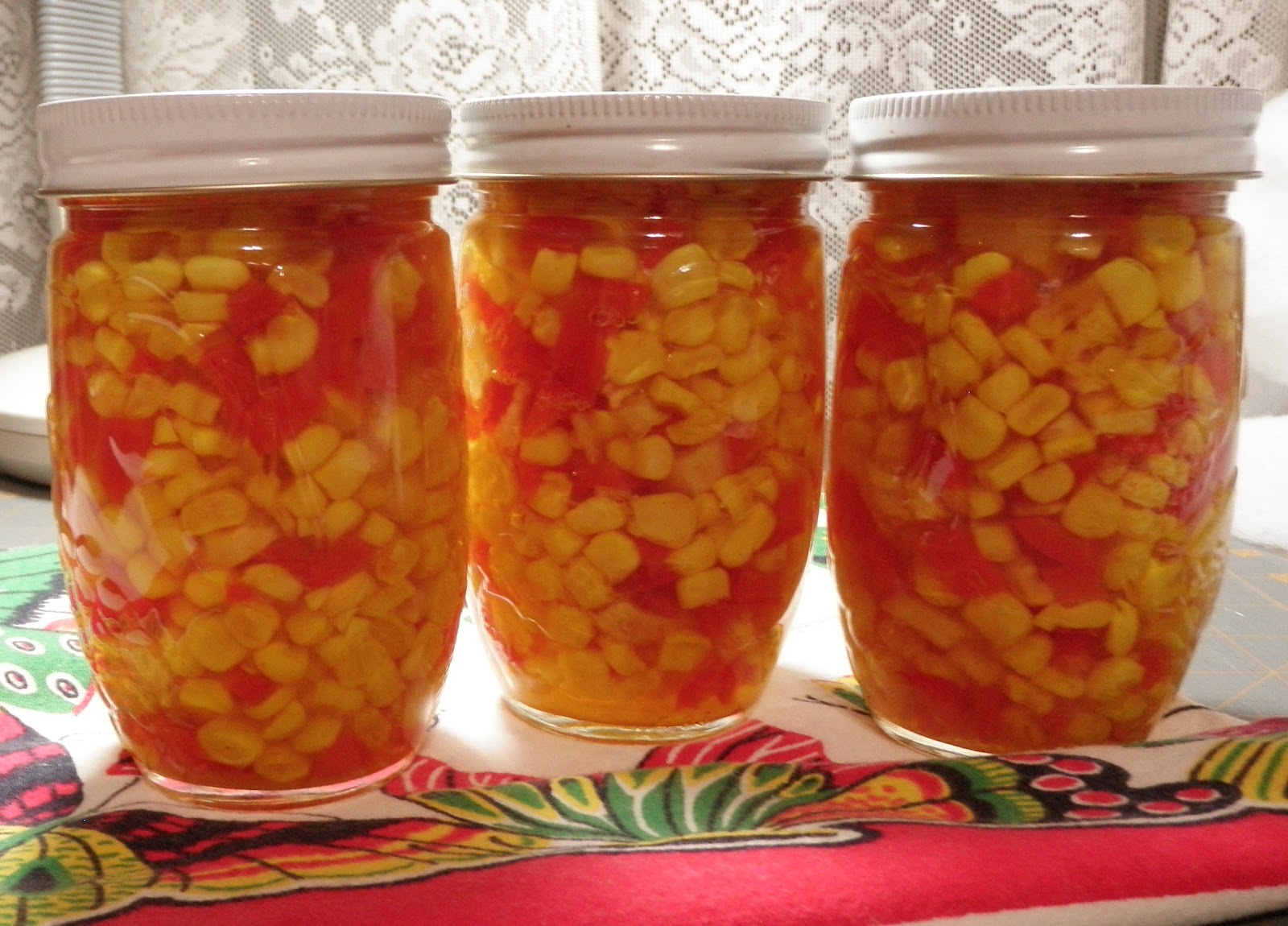
Even though there are just a few recipes on a wide range of topics, it's still worth a trip to your local library to check it out. Maybe it has the recipe you've been searching for!
Do you know what to use Sweet Pepper Corn Relish for??
Have a great day, and take care of you!
Wednesday, June 13, 2012
An oldie, but a goodie!
THE COMPLETE BOOK OF SMALL-BATCH PRESERVING by Ellie Topp and Margaret Howard is in its third revised/expanded edition. It was updated last in 2007. It's one of the few books I purchased after borrowing it from the library. It has over 300 recipes designed for year-round preserving...it is awesome.
This book gives each recipe in US measurements and metric measurements...always nice for those of you who understand the metric system.
I have made the jalapeno jelly from this book. I personally think that jalapeno jelly is YUCKY, but my husband and his buddies seem to really enjoy jalapeno jelly over cream cheese on crackers. Whatever floats their boats.
I wanted to make something new, though. So...I found super cheap blackberries when I was at the store. Maybe someone accidentally ordered too many?? Somebody put the wrong price down?? I just grabbed and dashed to the checkout, giddy with my find...
For less than $4, I made a cute little batch of blackberry jam. I didn't find many blackberry-specific recipes in any book, so I used the raspberry jam recipe from THE COMPLETE BOOK OF SMALL-BATCH PRESERVING. It worked great. It was supposed to make 4 cups (or 4 - 1/2 pint jars.) I put them in 1/4 pint jars, and I got 10 - 1/4 pints (or 5 - 1/2 pint jars.)
If I'm smart and hold onto several jars of different types of jelly, jams, and preserves, these make great gift baskets at Christmas. An inexpensive basket from a thrift shop, some cute material, an assortment of home-canned goods, and a box of crackers or scones...trust me...that is a gift that is appreciated. Of course, if you are like me, you've given away anything you didn't eat yourself long before Christmas rolls around. Oh, well.
Have a great week, and take care of you!
This book gives each recipe in US measurements and metric measurements...always nice for those of you who understand the metric system.
I have made the jalapeno jelly from this book. I personally think that jalapeno jelly is YUCKY, but my husband and his buddies seem to really enjoy jalapeno jelly over cream cheese on crackers. Whatever floats their boats.
I wanted to make something new, though. So...I found super cheap blackberries when I was at the store. Maybe someone accidentally ordered too many?? Somebody put the wrong price down?? I just grabbed and dashed to the checkout, giddy with my find...
For less than $4, I made a cute little batch of blackberry jam. I didn't find many blackberry-specific recipes in any book, so I used the raspberry jam recipe from THE COMPLETE BOOK OF SMALL-BATCH PRESERVING. It worked great. It was supposed to make 4 cups (or 4 - 1/2 pint jars.) I put them in 1/4 pint jars, and I got 10 - 1/4 pints (or 5 - 1/2 pint jars.)
 |
| Isn't the color beautiful? |
Have a great week, and take care of you!
Wednesday, June 6, 2012
The Best Little Book of Preserves & Pickles
For the next several weeks I'll be highlighting some newer canning / preserving books. I decided that I really shouldn't review the book without at least trying one of the recipes...so I'll also be showing you the results of my efforts.
Author Judith Choate has put together an affordable, easy-to-follow book with several recipes for "easy jams & jellies, chutneys & condiments, sauces, spreads & syrups." She begins with a chapter of basic information about ingredients and a chapter about equipment and techniques. There are then eight chapters of recipes. There are a wide range of recipes that, for the most part, had ingredients I had heard of and would actually be able to easily acquire (if I didn't already have the ingredient in my pantry.) This is awesome because Nebraska does not necessarily have "fancy" ingredients found in some cookbooks...and if I haven't heard of it or I don't know what it is...I'm a little leery of spending my hard-earned pennies on it. Maybe that's just me...
Also, this book is designed for small batch preserving. I like small batch preserving because it is easier when you are canning by yourself. Or, if you bought to much of something, you can preserve the goodness rather than letting food going to waste.
In addition to traditional jams, jellies, chutneys, preserves, conserves, relishes, and pickles, she also has recipes for canning your own:
The preserves were a three day process, but the time commitment was not bad on any day. The first day involved cleaning and coring the strawberries and adding the sugar. Day two was around an hour worth of heating up and boiling the strawberry / sugar mixture. Day three was the longer time commitment. Heat the strawberry mixture back up to boiling and water bath for 10 minutes.
The recipe said it would make 4 - 1/2 pint jars. I actually got 5 - 1/2 pint jars. I am completely okay with that!
What's your favorite fruit to can? Have a wonderful and wacky Wednesday, and take care of you!
Author Judith Choate has put together an affordable, easy-to-follow book with several recipes for "easy jams & jellies, chutneys & condiments, sauces, spreads & syrups." She begins with a chapter of basic information about ingredients and a chapter about equipment and techniques. There are then eight chapters of recipes. There are a wide range of recipes that, for the most part, had ingredients I had heard of and would actually be able to easily acquire (if I didn't already have the ingredient in my pantry.) This is awesome because Nebraska does not necessarily have "fancy" ingredients found in some cookbooks...and if I haven't heard of it or I don't know what it is...I'm a little leery of spending my hard-earned pennies on it. Maybe that's just me...
Also, this book is designed for small batch preserving. I like small batch preserving because it is easier when you are canning by yourself. Or, if you bought to much of something, you can preserve the goodness rather than letting food going to waste.
In addition to traditional jams, jellies, chutneys, preserves, conserves, relishes, and pickles, she also has recipes for canning your own:
- sauces and marinades like teriyaki sauce and barbeque sauce
- dessert sauces like white chocolate sauce and red hot apple syrup
- condiments and dressings like fresh horseradish, spicy beer mustard, and hot and sour salad dressing
The preserves were a three day process, but the time commitment was not bad on any day. The first day involved cleaning and coring the strawberries and adding the sugar. Day two was around an hour worth of heating up and boiling the strawberry / sugar mixture. Day three was the longer time commitment. Heat the strawberry mixture back up to boiling and water bath for 10 minutes.
The recipe said it would make 4 - 1/2 pint jars. I actually got 5 - 1/2 pint jars. I am completely okay with that!
 |
| There's only 4 jars in the picture because my brother had already stopped by to take one jar home. |
Subscribe to:
Posts (Atom)